There is a styling problem that most Indian professional women solve imperfectly every single day.
It begins at eight in the morning, when you are dressing for a full day that includes a 10 AM presentation, lunch with a client, a 4 PM internal review, and — if the calendar does not lie to you — drinks with friends at seven followed by a dinner reservation at nine.
You know what to wear. The difficulty is the jewellery.
What reads as appropriate in a boardroom does not automatically hold its ground at an evening table. What is striking enough for a dinner with friends can feel performative in a meeting. The heavy gold necklace that works brilliantly at a Diwali gathering requires a full outfit reorganisation before it can be taken anywhere near a formal presentation. And the plain pearl studs that satisfy your 10 AM audience look, by eight in the evening, like you forgot to change.
This is not a small problem. Indian professional women navigate a dress code spectrum that exists nowhere else on earth — from conservative banking and law firms where sarees and Anarkalis are appropriate daily to Bengaluru startup offices where smart casual is the ceiling, with every variation in between. The jewellery that works across this entire range is, in practice, an extremely small category.
The lab-grown diamond solitaire belongs to it.
Why the spectrum matters more than you think
A generic international workwear guide will tell you to wear "minimalist jewellery" to the office. That is correct but unhelpful without acknowledging the specific complexity of Indian professional dressing.
In a traditional Indian corporate environment — a law firm in Delhi, a bank headquarters in Mumbai, an established family business in Kolkata — jewellery is not optional. A woman who wears nothing is as conspicuously under-dressed as one who wears too much. The question is not whether to wear jewellery but how to choose it. A heavy polki set or a statement necklace is too much for a regular Tuesday. Nothing at all reads as not quite put-together. The space between those two poles, in a traditional corporate context, belongs to fine jewellery that is real without being ostentatious.
In a tech or startup environment, the logic is different. Jewellery signals intentionality rather than formality — the sense that you made a considered choice rather than defaulting to convention. A piece that is clearly fine, clearly crafted, and clearly understated communicates something different from decorative or costume jewellery, even in a casual context.
In a multinational or creative environment, versatility is the premium quality. Pieces that photograph well, that survive video calls without creating visual noise, that work with both Western formals and Indo-western ensembles across a day — these are the pieces that earn their place in a working wardrobe.
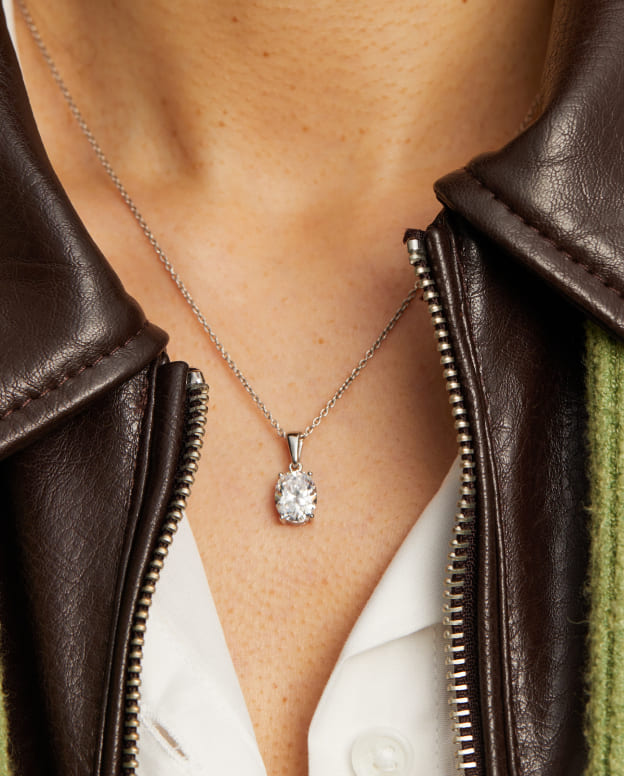
The solitaire diamond — a single round brilliant on a delicate chain, or set simply in a classic prong or bezel — performs across all three of these contexts. This is rare. Most jewellery optimises for one.
What "office to evening" actually requires
The transition from office to evening in an Indian urban context is not primarily a clothing problem. Most Indian professional women have learned to use their wardrobe with enough skill that the basics — swapping shoes, removing a blazer, adding a lip — handle the shift. The harder problem is jewellery.
Evening jewellery needs to hold its own in restaurant lighting, in photographs, in the presence of other women who have dressed specifically for the occasion. It needs to be enough. Office jewellery needs to not interfere — with the impression you are creating, with the content of your presentation, with the professional authority you have built over years. It needs to be restrained enough.
The diamond solitaire occupies a rare position on this spectrum. Under office fluorescence, it catches light subtly — present, considered, but not demanding attention. In restaurant candlelight or the ambient lighting of a dinner table, the same stone changes character. The same cut facets that produce quiet, scattered light in a conference room produce something warmer and more alive in the golden light of an evening out. The piece does not change. The context does. The diamond is one of very few jewellery materials that responds to this contextual shift gracefully.
This is not true of most alternatives. A delicate gold chain without a stone looks the same in both contexts — pleasant at the office, perhaps underpowered at dinner. A statement piece does the reverse. Pearls have their own beautiful logic but tend toward formality. Coloured gemstones carry aesthetic associations that can compete with outfit choices rather than support them. The diamond, specifically the solitaire, is the one piece that accelerates naturally from office to evening without requiring its wearer to do anything except let the setting change.
The case for lab-grown in this specific context
The daily-wear case for lab-grown diamonds is, at its core, an economic and practical argument.
A diamond solitaire that you intend to wear every day — through commutes, client meetings, airport security, impromptu dinners — is not treated gently. It is worn in the real conditions of a real life. The difference between a stone that costs ₹1,20,000 and one that costs ₹30,000 for comparable quality is not, in the context of daily wear, a question of value. It is a question of what you do to yourself psychologically when you scratch the prong on a briefcase handle or notice the setting has loosened after an unexpected day in the rain.
Lab-grown diamonds — identical in hardness, chemical composition, and optical properties to mined stones — are worn differently when you paid less for them. Not more carelessly, but more freely. The anxiety that surrounds an expensive mined stone, the slight hesitation before an outdoor event or an evening involving dancing, the mental calculation about whether today is a "diamond day" — these dissolve when the piece costs what it should, rather than what a century of artificial scarcity decided it should.
This is the specific quality that makes lab-grown ideal for the working-woman use case. It is not that the stone is inferior. It is that a piece you can wear without second-guessing is a piece you will actually wear — every day, across the full twelve hours, into the contexts where fine jewellery has historically stayed in the locker.
How to wear it across the day
The solitaire pendant works as a complete jewellery answer for most of the professional Indian woman's daily contexts, but a few specific notes are worth making.
With a formal saree or structured blazer: A pendant at the collarbone length — roughly 18 inches — sits cleanly above a blouse neckline or inside a shirt collar. The diamond catches the light at the chest level where it registers peripherally in a meeting rather than front-and-centre. This is the right register for a formal context.
In a traditional or conservative office environment: A smaller stone (0.20 to 0.35 carats) in an 18-karat yellow gold setting reads as genuine, considered, and appropriate without any risk of being read as flashy. Yellow gold also bridges the aesthetic gap between Western and Indian professional dressing better than white gold in many traditional contexts.
For the evening transition: The same pendant, worn the same way, gains significance as ambient lighting warms. If you want to build on it for an evening out without carrying extra pieces, a pair of small diamond studs complement the solitaire without competing — the classic two-piece combination that essentially answers all evening occasions.
With Indian occasion wear: The solitaire pendant is also where the modern mangalsutra has been quietly relocating. Married professional women who want to wear their mangalsutra symbol in a form that is appropriate at a client meeting and readable at a family dinner are increasingly choosing a single diamond pendant on a thin gold chain. It carries the cultural meaning intact. It reads as fine jewellery in a boardroom context. It does not require the wearer to choose between tradition and professionalism.
The practical minimum
If you are building the jewellery foundation for a working wardrobe from scratch, the most honest advice is this: start with one piece. Not a set, not a collection — one piece that you will wear every day.
A round brilliant diamond solitaire pendant, between 0.25 and 0.40 carats, in 18-karat gold (yellow for a warmer aesthetic, white for a cooler, more contemporary one), on a fine chain at collarbone length, certified by IGI, lab-grown. This is ₹25,000 to ₹60,000 — broadly the price range of a quality leather bag or a good pair of shoes.
This is the piece that will be on your neck in a Monday morning meeting, at a Friday evening restaurant, at a Saturday family occasion, and at a Sunday brunch. It will work. You will not have to think about it. And in the context of Indian professional life, where enough mental energy is already spent navigating every other version of dress-code calculus — that particular freedom is worth more than almost anything a piece of jewellery can offer.